
Your Second Brain: Why the Path to Happiness Runs Through the Gut

Have you ever felt those nervous ‘butterflies in your stomach’ before a first date? Or did you suddenly have to rush to the bathroom before an important job interview? Those feelings are no coincidence. They are the first clear signs of one of the most complex communication networks in your body: the gut-brain axis.
For a long time, it was thought that our brain was the undisputed boss of our body. Everything we felt, thought, and did was controlled from the top down. But science in recent years has completely changed that image. Your gut turns out not to be a passive food-processing factory, but a smart system that constantly communicates with your brain. In fact, your gut often has more to say to your brain than the other way around.
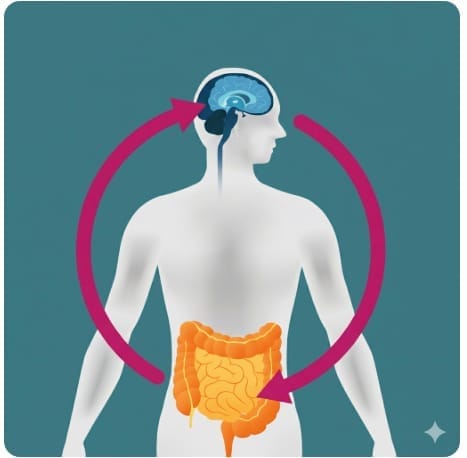
Imagine a busy fiber-optic cable running between your skull and your digestive system. Over this cable, millions of messages are sent every second. This network is what we call the gut-brain axis.
This connection consists of three main pathways:
The Physical Pathway: The Vagus Nerve
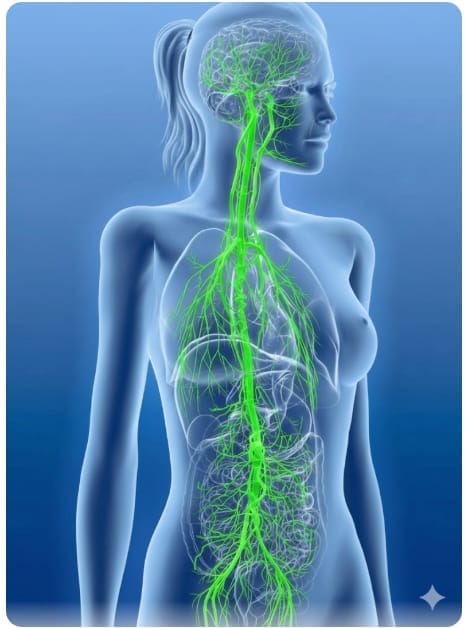
The Vagus Nerve, also known as the "wandering nerve," is the most important player in this story. It is the longest nerve of the autonomic nervous system and runs directly from the brainstem to the gut. You can essentially think of it as a direct telephone line. While your brain manages digestion, as much as 80% to 90% of the fibers in this nerve consist of signals sent from the gut to the brain. Your gut is, in a sense, constantly providing status updates on how full you feel, how your immune system is functioning, and even whether harmful bacteria are present.
The Chemical Pathway: Neurotransmitters. You might think that substances like serotonin (the "happiness hormone") and dopamine (the "reward signal") are only produced in the brain. But that's not true at all! About 95% of the serotonin in your body is located in your gut. Here, it not only plays a role in gut movement, but it also sends signals to your brain that influence your mood and sleep.
The Microbial Pathway: The Microbiome
In your gut live countless bacteria, fungi, and yeasts—trillions of them! Together, they weigh almost as much as your brain, around 1.5 kg. This 'microbiome' produces chemical substances that enter your blood through the gut wall, which influences how your brain functions.
The Microbiome: The Conductor of Your Mood
It sounds almost like science fiction: tiny organisms in your belly determining whether you feel anxious or cheerful today. Yet, research points exactly in that direction.
Researchers first discovered this in mice. When they transplanted the gut flora of a fearful, anxious mouse into a brave one, the mouse suddenly began to exhibit anxious behavior. The conclusion was shocking: personality was not just in the genes or upbringing, but in the bacteria.
In humans, we see similar patterns. People with clinical depression often have less diverse gut flora than people without depression. Certain groups of bacteria appear to produce anti-inflammatory substances that protect the brain, while a shortage of those bacteria opens the door to low mood and 'brain fog.'
The Cycle of Stress: Why Stomach Pain and Burnout Go Hand in Hand
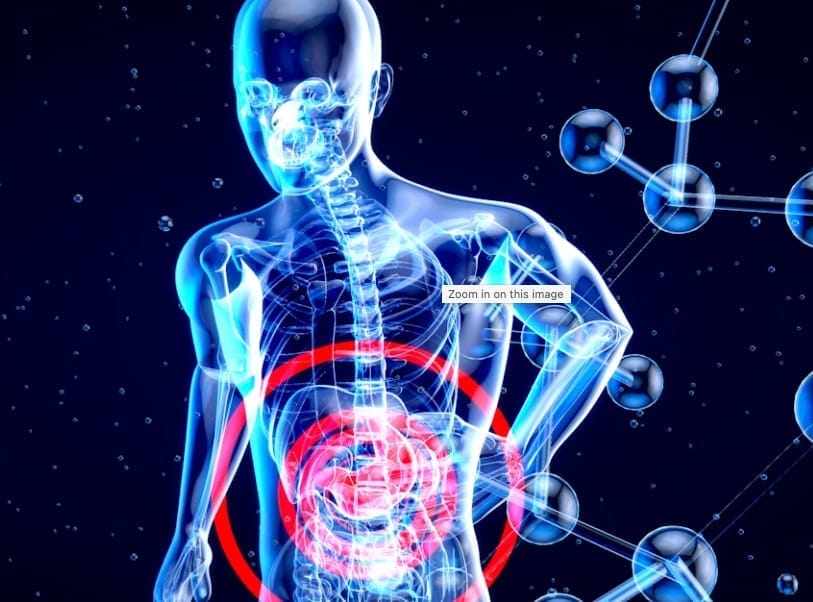
The gut-brain axis works in both directions, and that is exactly why chronic stress has such a major impact on your digestion. When your brain experiences stress—whether it's from work, relationships, or trauma—your body switches to 'fight-or-flight' mode. At that moment, your digestion does not receive the attention it needs. Blood flow to your intestines decreases, and the production of protective mucus stops. If this situation lasts too long, the gut wall becomes more vulnerable. Microscopic openings develop—a phenomenon we often call 'leaky gut.' This allows particles and bacteria to enter your bloodstream where they don't belong. Your immune system sounds the alarm, leading to low-grade inflammation. And where do those inflammatory signals go? Exactly, back to your brain via the Vagus Nerve, making you feel even more stressed and exhausted.
The Rise of Psychobiotics
Now that we know how strong the connection is between our gut and our mind, we are seeing a new medical trend emerge: Psychobiotics. These are specific types of probiotics (the good bacteria) that, when used in the correct amounts, can have a positive effect on your mental health. Instead of focusing solely on therapy or antidepressants, doctors are now also looking at what is on the patient's plate. Could a course of certain bacteria help reduce the anxiety response in the brain? The first results are promising. This suggests that in the future, we might be able to tackle mental health issues, at least in part, through our gut.

How Do You Recognize an Imbalance?
How do you know if your gut-brain axis is out of balance? The symptoms are often a mix of physical and mental discomfort:
Digestive issues: Regularly feeling bloated, constipated, or having diarrhea (often linked to IBS).
Brain Fog: Difficulty concentrating, forgetfulness, or a "fuzzy" feeling in the head.
Mood Swings: Unexplained irritability or feelings of anxiety.
Sugar cravings: Bad bacteria survive on sugar and can send signals to your brain that compel you to eat unhealthily.
Practical: How to Strengthen the Gut-Brain Axis?
The science is interesting, but what can you actually do with it today? Fortunately, the gut flora is very resilient. With the right adjustments, you can start noticing a difference in your energy levels and mood within just a few weeks.

A. Eat Diversely (The 30-Plant Rule) The most important factor for a healthy microbiome is diversity. Scientists recommend eating 30 different types of plant-based products per week. Think of vegetables, fruit, whole grains, nuts, seeds, and herbs. This is because every type of bacteria has its own favorite food.
B. Embrace Fermentation Fermented products contain live bacteria that directly support your gut flora.
Kefir: A drinkable yogurt rich in probiotics.
Sauerkraut & Kimchi: Fermented vegetables.
Kombucha: Fermented tea.
Tempeh: Fermented soybeans.
C. Feed the Good Bacteria (Prebiotics). Probiotics are the bacteria themselves; prebiotics are the food for those bacteria. These are indigestible fibers found in garlic, onions, asparagus, bananas, and oatmeal. Without prebiotics, the good bacteria cannot survive for long.
D. Activate your Vagus Nerve You can train the physical connection between your gut and your brain. Because the Vagus Nerve is connected to your vocal cords and your diaphragm, you can stimulate it through:
Deep belly breathing: This signals to your nervous system that you are safe.
Cold water: Washing your face with ice water or taking a cold shower stimulates the nerve response.
Singing or humming: The vibrations in your throat activate the nerve directly.
E. Limit 'Microbiome Killers' Some things are outright toxic to your gut flora:
Excessive antibiotic use: While sometimes necessary, antibiotics act like an atomic bomb on your gut flora; they kill both the bad and the good bacteria.
Ultra-processed food: Emulsifiers and artificial sweeteners can damage the protective mucus layer of your intestines.
Chronic sleep deprivation: Your gut bacteria also have a circadian rhythm; if you don't sleep, they get confused.
The Future: Health is Holistic
The discovery of the gut-brain axis marks a significant shift in how we look at our bodies. In the future, cardiologists, psychologists, and gastroenterologists will increasingly need to join forces. It is a powerful idea: you have more influence over your mental well-being than you might think. By taking good care of your gut, you are also taking care of your mind. So, the next time you feel down, it is not only important to examine your thoughts, but also to ask yourself: "What have I eaten?" and "How does my stomach feel?". Your gut is not just responsible for digestion; it acts like an internal compass. Listen to your gut feeling—both literally and figuratively.
One last thing: start small
You don’t have to overhaul your entire life all at once. Start, for example, with one extra serving of vegetables a day, replace your soda with kombucha, or take a moment three times a day to breathe deeply into your belly. Your gut will pick up the signals, your Vagus Nerve will pass them on, and your brain will thank you with more peace, focus, and joy.
Noël
Harvard Health: The gut-brain connection https://www.health.harvard.edu/diseases-and-conditions/the-gut-brain-connection
Nature: The microbiota–gut–brain axis (Scientific Review) https://www.nature.com/articles/s41579-020-00460-0
Cleveland Clinic: Gut-Brain Connection https://my.clevelandclinic.org/health/body/the-gut-brain-connection
Psychology Today: The Gut-Brain Axis https://www.psychologytoday.com/us/basics/the-gut-brain-axis
Cell Host & Microbe: The gut-brain axis: Retrospective and prospective (2025/2026 Overview) https://www.cell.com/cell-host-microbe/home
The Vagus Nerve Society: Research on Vagal Tone and Mental Health https://vagusnerve.org/research/
Scientific American: Gut Bacteria May Exert Control over Every Aspect of Your Health https://www.scientificamerican.com/article/gut-bacteria-may-exert-control-over-every-aspect-of-your-health/
Created by © Noël