
Your Own Health Detective: How You Take Control with a 'Biomarker Audit'
Many people only seek medical help when there’s a real problem. We wait until an alarm goes off in our body, hoping that the doctor can fix it quickly. But what if you could prevent those issues?
Welcome to the world of Biomarker Audit. By regularly checking your blood values, especially those that go beyond standard tests, you gain valuable insights into your overall health and vitality.
Why "normal" isn't always enough: When you have a blood test done, your results are often compared to the average of the general population. But let’s be honest: many people in the Netherlands often feel tired, have a high body fat percentage, or suffer from vague health complaints.
If you want to stand out from the crowd and bring out the best in yourself, it’s important to look at ideal values.
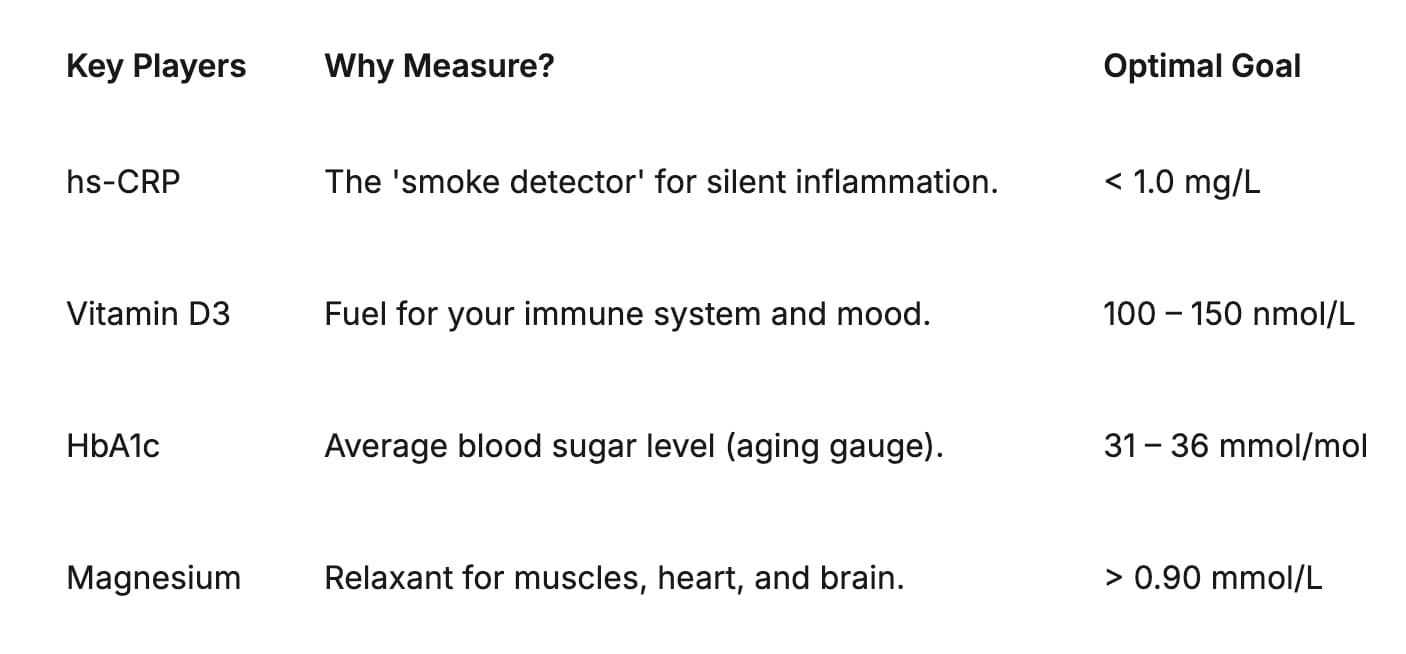
Talking to Your GP: How to Handle the Conversation
Many people feel nervous about requesting extra tests. "The doctor will think I'm being difficult" is a thought most of us have had. The key is to show up not as someone making demands, but as an active participant in your own health.
A conversation starter that works: "I've been putting together a preventive health plan, and I'd like to establish a baseline — specifically my hs-CRP and Vitamin D3 levels. I know this probably falls outside your standard protocol, and I'm happy to cover the cost through my own deductible."
Signaling that you're willing to pay and that your goal is prevention takes most of the friction out of the conversation before it even starts.
Your results are in — now what?
A number on a lab slip means nothing without action. If something falls in the "orange zone," here's where to start:
hs-CRP elevated? Cut processed sugars, add more oily fish (omega-3s) to your diet, and book a visit to your dental hygienist — gum health and systemic inflammation are more connected than most people realize.
Vitamin D low? Always supplement D3 alongside Vitamin K2 — K2 helps direct calcium into your bones rather than your arteries. Take it with a fat-containing meal for better absorption.
Magnesium on the low end? Go with Magnesium Bisglycinate (better suited for evenings) or Malate (for daytime use). Avoid the cheap Oxide form — it's mainly a laxative and does very little at the cellular level.
Become the expert on your own body
Your blood values aren't fixed — they're a snapshot of how you're currently living. Checking in every 6 to 12 months tells you whether your diet changes, exercise habits, or supplements are actually doing anything.
Stop guessing. Start measuring. Your future self will thank you.
Checklist: My Biomarker Audit Goal: A preventive baseline assessment of vital functions and inflammation markers.
🩸 Tests to request:
hs-CRP (High-sensitivity CRP) — measures low-grade systemic inflammation; more precise than a standard inflammation marker
Vitamin D3 (25-hydroxyvitamin D) — supports immune function and bone health; target above 100 nmol/L
HbA1c — reflects average blood sugar over the past 3 months; useful for catching early insulin resistance
Magnesium — checks mineral status; ideally tested alongside potassium
Lipid panel (with ratios) — not just total cholesterol, but specifically the HDL/LDL ratio and triglycerides
💬 Talking points for your appointment:
Prevention framing: "I want to use these values as a benchmark for my lifestyle changes — diet, movement, sleep."
Symptom check-in: "I've been noticing [fatigue/stiffness/brain fog — fill in as relevant], and I want to rule out whether suboptimal levels might be playing a role."
Cost acknowledgment: "I understand this may fall outside the standard protocol, and I'm fine with it going toward my deductible."
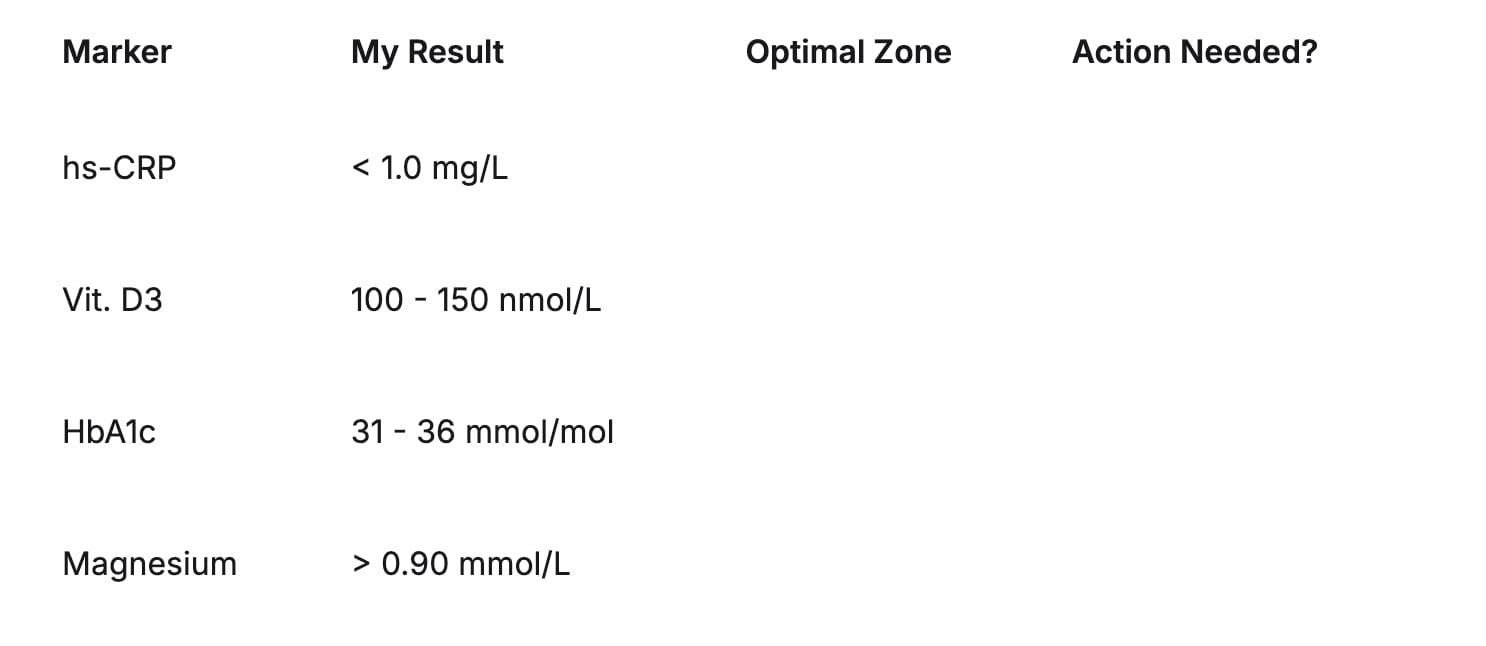
📝 Notes for the results (fill in yourself):
Date of blood draw: _____________________________________
💡 Pro-tip for the lab:
Ask if you can receive the results digitally through the patient portal. This way, you can compare the raw data (the numbers) with the optimal values yourself, rather than just being told that it's "good."
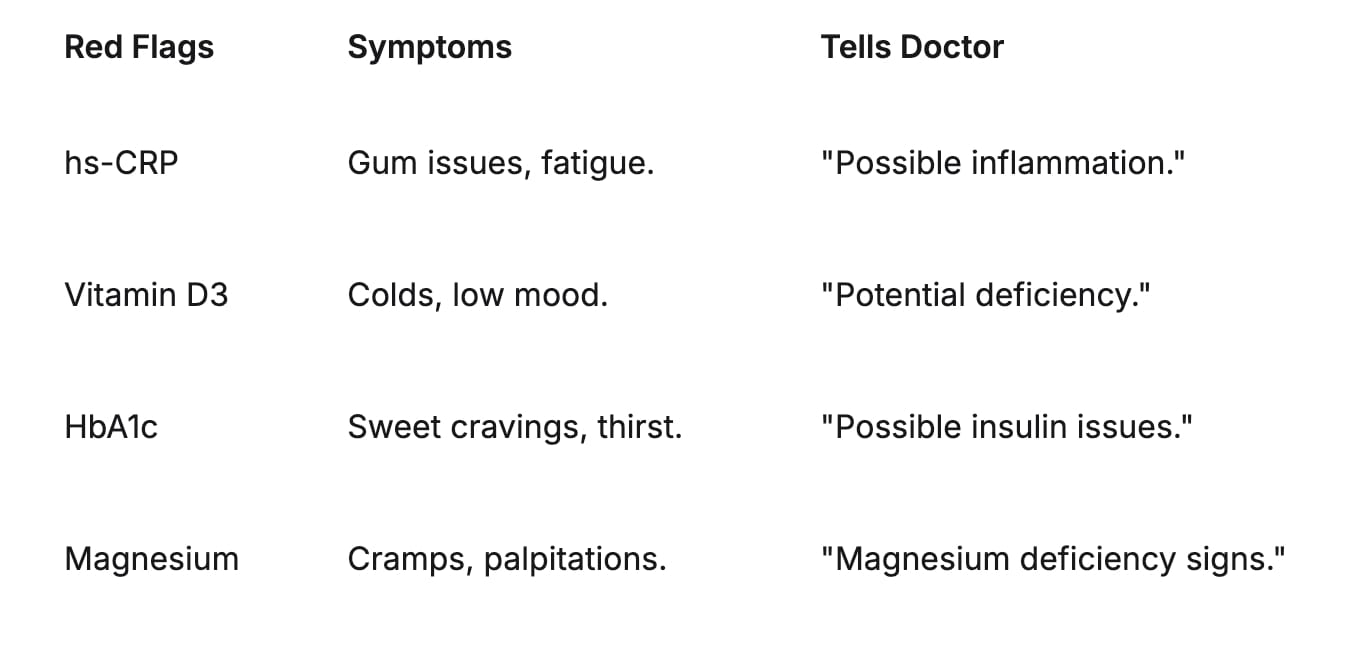
The proverbial "stick behind the door" is when you can tell a doctor why you want a test based on specific signals from your body, turning the conversation from a "request" into a medical necessity.
Link your complaints to this list to strengthen your argument:
How to Use This in the Conversation
Instead of saying, "I want to know my magnesium levels," say:
"Doctor, I've been experiencing eyelid twitches and calf cramps lately, which are often linked to magnesium deficiency. Additionally, I’m slowly recovering from exertion, which makes me think of elevated inflammatory levels (hs-CRP). I would like to objectify this with a blood test."
Why This Works:
Objectivity: You connect a subjective feeling (tiredness) to an objective symptom (cramps).
Knowledge: You demonstrate the link between biology and symptoms.
Help Request: You ask the doctor to help "objectify," which is their natural role.
What’s Your Plan?
You now have the script, the checklist, the optimal values, and the red flags. You’re better prepared than 95% of patients who walk into the office.
This is the final crucial step. Many people unintentionally influence their blood values by changing their behavior right before the test (e.g., eating extra healthy or doing a heavy workout). However, you want to see an honest average, not a "polished" result.
Here’s Your Protocol for the 7 Days Before the Test:
The "Pre-Test" Protocol
Stop Biotin (Vitamin B7/B8): 3 to 5 days prior. Biotin is in almost all "Hair, Skin & Nails" supplements and many multivitamins. It can technically disrupt lab tests for thyroid levels and heart markers (such as Troponin), leading to false positives or false negatives.
No Heavy Weight Training: 48 hours prior. Extreme physical exertion can cause temporary microdamage to muscles. This can artificially raise your hs-CRP (inflammation marker) and creatinine (a marker of kidney function). Stick to walking or light yoga for the two days before the test.
Supplement Break: 24 hours prior. Do not take additional Magnesium, Vitamin D, or Omega-3 supplements the day before the test. You want to measure your body’s baseline, not the peak level after taking a capsule.
Fasting: 12 hours prior. For a pure HbA1c and especially for your Triglycerides (fats) and fasting blood sugar, do not eat anything for 12 hours before.
Do: Drink water (essential! Hydration makes the blood draw easier).
Don’t: Consume coffee, tea (even without sugar), gum, or sports drinks.
🕒 Test Day: Timing is Everything
Get Tested Early: Ideally between 8:00 and 9:00 AM. Your hormone levels (like cortisol) and glucose values follow a circadian rhythm and are most consistent in the morning for comparison.
Stay Calm: Stress right before the test can raise your glucose and blood pressure. Arrive 10 minutes early and sit calmly in the waiting room.
Summary Action Plan
Now: Schedule your appointment with the checklist and script.
Week of the Test: Follow the above protocol.
After the Results: Compare your numbers to the "Optimal Values" table we created earlier.
You are now fully equipped to take charge of your health. Do you have any questions about a specific value, or are you ready to make that appointment?
Noël
Created by © Noël