
Unlocking the \"Sleeping Seeds\": Could Old Drugs Be the Key to New Cancer Hope?
For decades, the fight against cancer has largely focused on a powerful but often blunt approach: chemotherapy, radiation, and surgery. These treatments have saved countless lives, yet the elusive nature of cancer means it often finds a way to return. Why? Many scientists now believe the answer lies within tiny, highly resilient cells known as Cancer Stem Cells (CSCs). These "sleeping seeds" are the ultimate survivors, often escaping conventional therapies only to re-ignite the disease later.
But what if the key to stopping these tenacious cells isn't a brand-new, expensive drug, but rather a pair of humble, decades-old medications primarily used for something entirely different: deworming? This intriguing question is at the heart of a growing wave of research, particularly from institutions in China, suggesting that anti-parasitic drugs like Fenbendazole and Ivermectin might hold a surprising secret in the war against cancer.
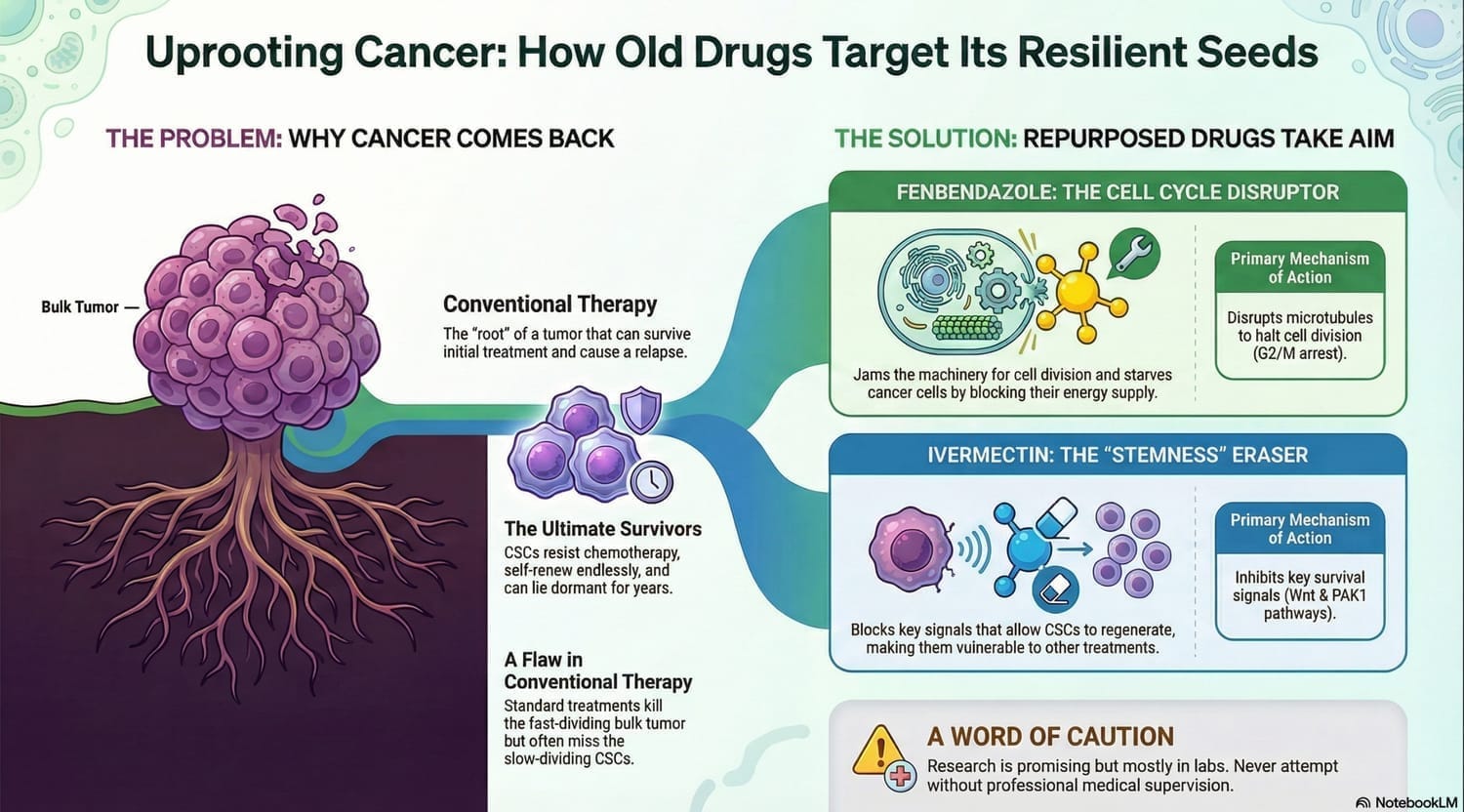
The Unseen Enemy: Understanding Cancer Stem Cells
Imagine a weed in your garden. You can cut down its leaves and branches (the "bulk" of the tumor), but if you don't pull out the root (the "cancer stem cell"), the weed will simply grow back. That's essentially the challenge posed by CSCs.
Resilience: Unlike ordinary cancer cells, CSCs are incredibly tough. They can resist chemotherapy, evade the immune system, and lie dormant for long periods, only to awaken and cause a relapse.
Self-Renewal: They have the unique ability to "self-renew," meaning they can create endless copies of themselves, effectively repopulating the tumor.
Metabolic Flexibility: They are masters of adapting, changing their energy sources to survive harsh conditions.
Traditional cancer treatments are excellent at destroying the rapidly dividing "bulk" of a tumor. However, because CSCs divide slowly and have unique survival mechanisms, they often slip through the net. This fundamental problem has led researchers to look for unconventional solutions.
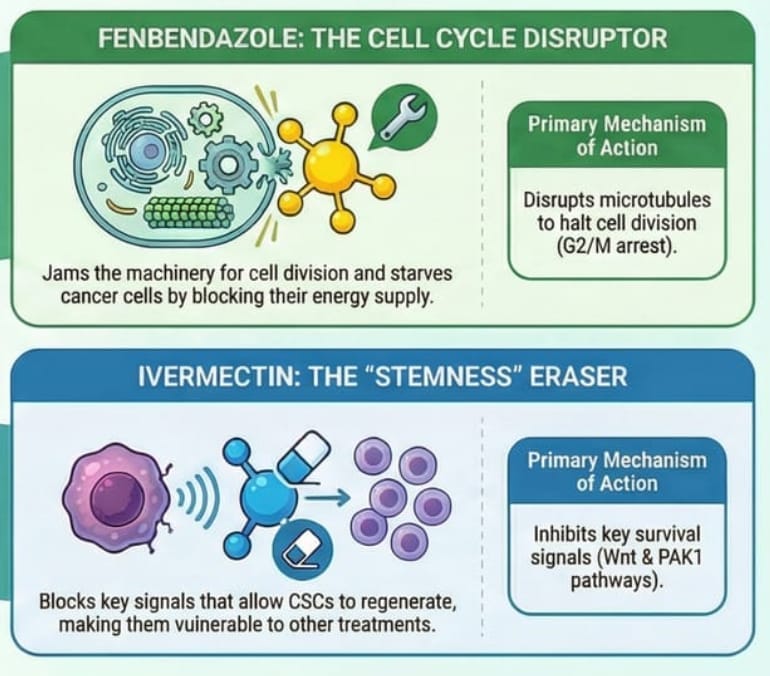
The Repurposed Hope: Fenbendazole and Ivermectin
Enter Fenbendazole and Ivermectin. These drugs are well-known in veterinary and human medicine for their effectiveness against parasites. But recently, a growing body of scientific literature, particularly from labs in China, has illuminated their potential in the fight against cancer, specifically their ability to target those elusive CSCs.
The appeal of these drugs is multi-faceted:
Safety Profile: They have been used safely in animals and humans for decades, meaning their side effects are generally well-understood at standard doses.
Affordability: As off-patent drugs, they are incredibly inexpensive compared to novel cancer therapeutics.
Accessibility: They are widely available globally.
It's precisely these reasons that make them less attractive to pharmaceutical companies seeking to patent and profit from new drugs, yet profoundly interesting to researchers and patients exploring alternative approaches.
Peeling Back the Layers: How Do They Work Against Cancer Stem Cells?
Chinese research has been instrumental in dissecting the mechanisms by which Fenbendazole and Ivermectin might exert their anti-cancer effects, especially against CSCs.
Fenbendazole: The Cell Cycle Disruptor
Imagine a busy factory where products are made on an assembly line. Cancer cells, especially CSCs, are like factories that never stop producing, constantly creating new cells. Fenbendazole appears to be a wrench in that assembly line.
Microtubule Mayhem: Fenbendazole primarily works by interfering with microtubules, which are like the cell's internal "skeleton" and its transportation system. During cell division, microtubules are crucial for pulling chromosomes apart into two new cells. Fenbendazole essentially jams this process, preventing cancer cells (including CSCs) from dividing properly. Chinese studies have shown it causes G2/M phase arrest, meaning it stops the cell cycle right before division.
Metabolic Blockade: Research from institutions like Capital Medical University in China has highlighted Fenbendazole's ability to target the metabolic weaknesses of cancer cells. It starves them by inhibiting their ability to take up glucose, the sugar they desperately need for energy.
Apoptosis Induction: By disrupting the cell's internal machinery and starving it of energy, Fenbendazole can trigger apoptosis, a process of programmed cell death. This is critical for getting rid of resilient CSCs.
A particularly notable study from Capital Medical University on cervical cancer demonstrated Fenbendazole’s ability to inhibit CSC proliferation and induce apoptosis, with impressive results in animal models.
Ivermectin: The "Stemness" Eraser
Ivermectin, another anti-parasitic, seems to tackle CSCs through a different, yet equally vital, pathway. Think of CSCs as having a secret switch that allows them to remain "stem-like" – constantly regenerating and resisting treatment. Ivermectin appears to flip that switch.
Blocking Key Signals: Research, including studies reviewed by Bengbu Medical College, shows Ivermectin can block crucial signaling pathways that cancer cells, especially CSCs, rely on to survive and maintain their "stemness." One key target is the Wnt/β-catenin pathway, a fundamental cellular communication system often hijacked by cancer to promote growth and self-renewal.
PAK1 Inhibition: Ivermectin has been shown to inhibit the PAK1 pathway, which is often overactive in many cancers, particularly those resistant to treatment. By blocking PAK1, Ivermectin can reduce the ability of CSCs to repair themselves and evade drug action.
Turning "Cold" Tumors "Hot": In studies on aggressive cancers like Triple-Negative Breast Cancer (TNBC), Ivermectin has shown potential to downregulate "stemness" genes (like Nanog, Oct4, and Sox2), effectively making these resilient CSCs less "stem-like" and more vulnerable to conventional therapies. It can even make tumors more visible to the immune system.
Targeted Impact: Research Across Cancer Types
The potential of Fenbendazole and Ivermectin against CSCs isn't confined to a single cancer type. Chinese researchers have investigated their effects across various malignancies:
Colorectal Cancer: Studies on drug-resistant colorectal cancer cells have shown that both Fenbendazole and Ivermectin can combat the mechanisms that make these cells resistant to standard chemotherapy like 5-Fluorouracil. They force resistant stem cells into cell cycle arrest and induce oxidative stress, essentially making them more fragile.
Breast Cancer: Particularly in aggressive forms like Triple-Negative Breast Cancer, Ivermectin has been highlighted for its ability to strip away the "stemness" of CSCs, making them more susceptible to treatment.
Lung Cancer: In Non-Small Cell Lung Cancer, Fenbendazole has shown promise in combination with metabolic inhibitors, effectively "starving" lung cancer stem cells and improving survival rates in animal models.
The Road Ahead: Hope and Caution
The findings from these Chinese studies and others provide a fascinating glimpse into a potential new avenue for cancer treatment. By specifically targeting the "sleeping "seeds"—the cancer stem cells—these repurposed drugs could theoretically reduce recurrence rates and make existing therapies more effective.
However, it's crucial to approach these findings with both hope and caution.
Laboratory vs. Clinic: The vast majority of this research is conducted in laboratories (in test tubes or animal models). While promising, human clinical trials are essential to confirm safety, optimal dosing, and effectiveness in real-world patients.
Medical Guidance is Paramount: Repurposing drugs for cancer is a complex endeavor. It should never be attempted without the guidance and supervision of a qualified medical professional, preferably an integrative oncologist experienced in this area. Interactions with other medications, potential side effects, and monitoring of patient health markers are critical.
The story of Fenbendazole and Ivermectin in cancer research is a testament to the idea that sometimes, the answers we seek can be found in unexpected places. While the journey from laboratory finding to approved treatment is long, the dedicated work of researchers, particularly those in China, is shedding new light on old drugs, offering a glimmer of hope that we might one day truly conquer cancer by finally uprooting its most resilient seeds.
Noël

Sources:
The specific study from 2025 regarding Fenbendazole and cervical cancer stem cells, conducted by researchers at Jilin University and other Chinese institutions, was published in the journal Molecules.
1. Key Fenbendazole Study (2025)
Study Title: "Fenbendazole Exhibits Antitumor Activity Against Cervical Cancer Through Dual Targeting of Cancer Cells and Cancer Stem Cells: Evidence from In Vitro and In Vivo Models"
Authors: Xi Lei, Yi Wang, Yuanyuan Chen, Jinyue Duan, Xin Gao, and Zhongyi Cong.
Journal: Molecules 2025, 30(11), 2377.
Core Insight: This study is particularly significant because it used immunomagnetic sorting to isolate specific cancer stem cells (CD133+ and CD44+) and demonstrated that Fenbendazole triggered G2/M phase arrest (stopping cell division) in those resistant "seeds" as effectively as it did in the main tumor mass.
2. Key Ivermectin Review (2020-2025)
Regarding Ivermectin and cancer stem cells (CSCs), much of the foundational research cited by authors like Kerrington comes from a major review published by researchers at Jilin University Second Hospital.
Study Title: "Progress in Understanding the Molecular Mechanisms Underlying the Antitumour Effects of Ivermectin"
Authors: Mingyang Liu, et al. (Correspondence: Tianmin Xu).
Journal: Drug Design, Development and Therapy (Published by Dove Medical Press).
3. Study on Colorectal Cancer (2021)
This study specifically looks at how Ivermectin targets the energy centers of colon cancer cells.
Study Title: "Ivermectin has New Application in Inhibiting Colorectal Cancer Cell Growth"
Journal: Frontiers in Pharmacology.
URL: https://www.frontiersin.org/journals/pharmacology/articles/10.3389/fphar.2021.717529/full
How to read these papers
When you open these links, you will see the "Abstract" first. This gives you a summary of the results. To find the specific evidence for the stem cell targeting you mentioned, look for sections in the full text labeled "CSC inhibition" or "Targeting CD133/CD44 markers."
Created by © Noël