
The Factory Analogy: How Cancer Stem Cells (CSCs) are Sabotaged
In a previous article, I shared a lot of data about Ivermectin and Fenbendazole. I realized that the sheer amount of scientific terminology can sometimes make it hard to see the "big picture."
To truly understand how Fenbendazole and Ivermectin might work together, it helps to step away from the microscope for a moment.
I wanted to find a way to explain the complex biology of cancer stem cells (CSCs) in a way that feels intuitive.
Whether you are a patient, a caregiver, or simply a curious reader, this "factory" analogy provides a clear mental map of how these repurposed drugs aim to dismantle the very engine of cancer.
Dismantling the Unstoppable: How a "Factory Shutdown" Could Target Cancer Stem Cells
Imagine a factory, not just any factory, but one that operates ceaselessly, 24 hours a day, seven days a week, never stopping its relentless production. Its sole purpose? To churn out identical products at an alarming rate, expanding its operations, seemingly immune to wear and tear. Now, imagine this factory is a cancer stem cell (CSC) – the elusive and formidable architects behind tumor growth, recurrence, and resistance to conventional therapies.
For too long, these "master cells" of cancer have presented a daunting challenge. While traditional chemotherapy and radiation might decimate the bulk of a tumor, they often leave these resilient CSCs untouched. It's like clearing a forest but leaving the seeds – given time, the forest will return. But what if we could disrupt their very core operations, shutting down their production lines, cutting off their fuel, and even reprogramming their internal logic?
Emerging research is exploring just this, with a fascinating analogy of a "factory shutdown" involving two compounds: Fenbendazole and Ivermectin. Let's break down this powerful metaphor.
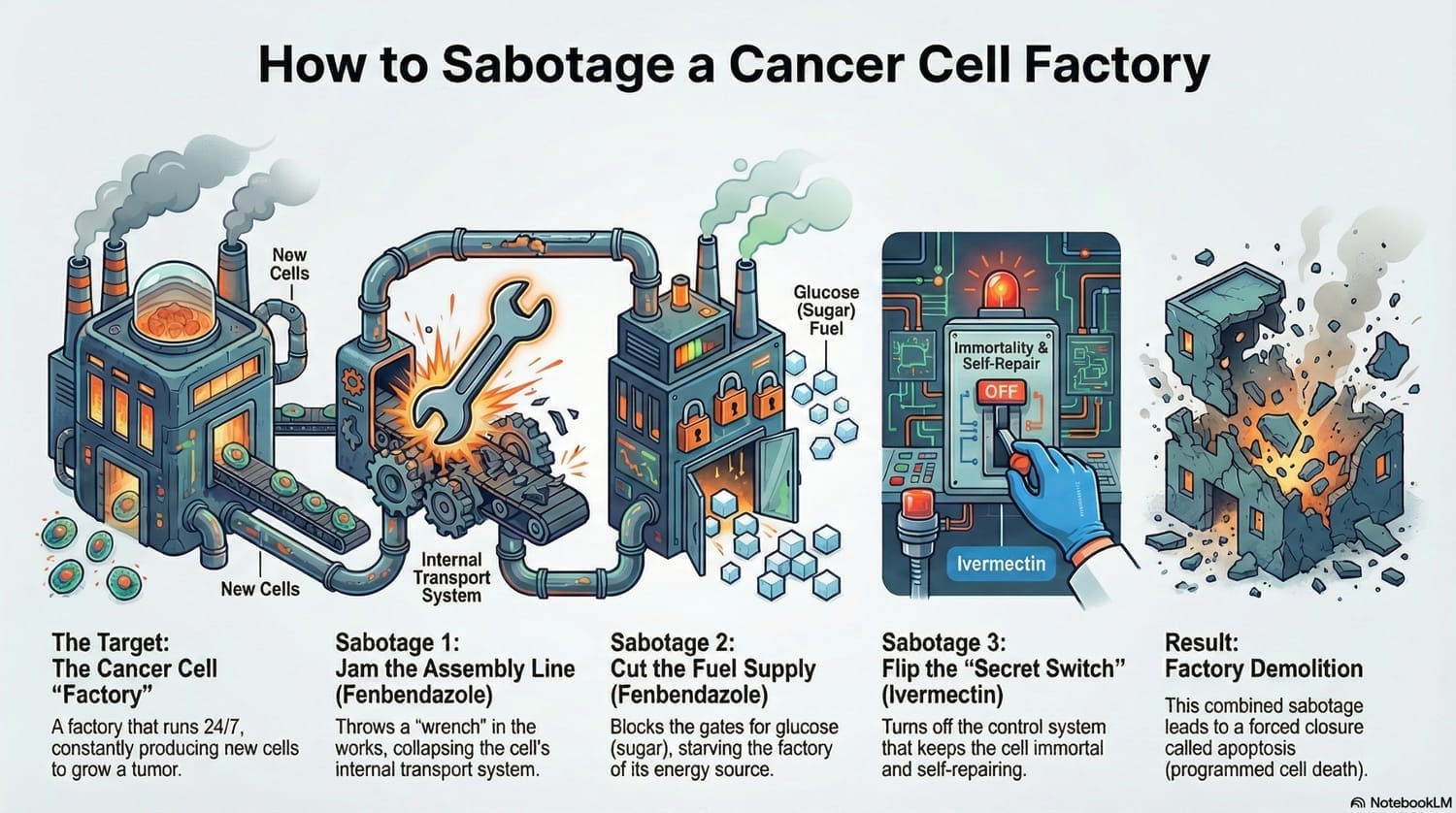
The Cancer Stem Cell: A Factory Gone Rogue
At the heart of this analogy is the cancer stem cell, tirelessly producing new cancerous cells. This factory is equipped with:
The Assembly Line (Microtubules): Inside the CSC, a complex internal transport system, known as microtubules, acts as the bustling assembly line. These vital structures are responsible for moving cellular components, segregating chromosomes during cell division, and essentially ensuring the factory can replicate itself into two new factories.
1.Fenbendazole: The Wrench in the Works & The Fuel Line Cut
Enter Fenbendazole, an anti-parasitic drug that's gaining attention for its potential anti-cancer properties. In our factory analogy, Fenbendazole plays a dual role, acting as both a mechanical saboteur and a resource denier:
The Wrench in the Works: Fenbendazole is like the "proverbial wrench" thrown into the gears of the assembly line. It directly interferes with the microtubules, causing this crucial internal scaffolding of the factory to collapse. Imagine the assembly line grinding to a halt, physically jammed just before the product (a new cell) is completed. This leads to G2/M phase arrest, meaning the factory can no longer divide and effectively stops producing.
Cutting the Fuel Line: Even the most efficient factory needs fuel, and cancer cells are notoriously "addicted" to sugar, specifically glucose. Fenbendazole has been observed to block the "gates" or glucose transporters that allow glucose to enter the cell. By cutting off this vital fuel supply, the factory is starved, its machines powered down, and its operations severely hampered.
Scientific Context for Fenbendazole: Early studies suggest Fenbendazole exerts its effects by disrupting microtubule formation, leading to cell cycle arrest and apoptosis in various cancer cell lines. It also appears to interfere with glucose metabolism in cancer cells.
2. Ivermectin: Flipping the "Secret Switch" and Firing the Management
While Fenbendazole focuses on the physical machinery and fuel, Ivermectin, another well-known anti-parasitic drug, targets the factory's control systems – its "software" and "management."
The "Secret Switch": Cancer stem cells possess a remarkable ability to remain in a perpetual "stem cell mode," granting them immortality and robust self-repair mechanisms. Ivermectin is likened to a "secret switch" that can simply be flipped off. This disrupts the CSC's ability to maintain its unique, undifferentiated state.
Firing the Management: Beyond the switch, Ivermectin effectively "fires the management" by blocking crucial signaling pathways, such as the Wnt/β-catenin pathway. This pathway is a master regulator of cell proliferation, differentiation, and stemness. By disrupting these communication lines, the factory "forgets" how to repair itself, how to maintain its stealth, and ultimately, how to function as a cancer stem cell.
Scientific Context for Ivermectin: Research indicates Ivermectin can inhibit the Wnt/β-catenin signaling pathway, a key driver of CSC properties, leading to reduced stemness, proliferation, and increased apoptosis in several cancer types.
3. The Grand Demolition: A Synergistic Shutdown
The true power of this approach lies in the potential synergy between Fenbendazole and Ivermectin. It's a multi-pronged attack:
A physical blockage of the production line (Fenbendazole's microtubule disruption).
A severe lack of essential fuel (Fenbendazole's glucose blockade).
The complete disabling of the factory's operating system and management (Ivermectin's targeting of stemness pathways).
This combination leads to a forced shutdown of the cancer stem cell factory, culminating in apoptosis – programmed cell death. Rather than just damaging cells, this approach aims to dismantle the very core of cancer's resilience.
4. Promising Avenues, Cautious Optimism
It's crucial to note that while these concepts are incredibly compelling, research into Fenbendazole and Ivermectin as anti-cancer agents, especially in combination, is still largely in preclinical stages (in vitro and animal studies). The leap from laboratory findings to human clinical application is significant and requires rigorous testing. However, the existing scientific literature provides intriguing insights into their potential mechanisms of action.
5. Conclusion
The analogy of the "unstoppable factory" offers a powerful way to understand the complex battle against cancer, particularly its stem cells. As research continues to unravel the intricate mechanisms of these repurposed drugs, the hope is that we can move closer to therapies that don't just clear the forest, but effectively dismantle the "seed factory" itself.
Noël
Sources on Combination & Repurposing
These articles discuss the broader strategy of combining these types of drugs to overcome treatment resistance:
Repositioning Antiparasitics for Cancer Therapy:
ResearchGate Review (2024). "Ivermectin, Mebendazole and Fenbendazole in the Treatment of Cancer."
Key Finding: Highlighting the mechanical roles of these drugs in targeting cancer-related parasites and inhibiting stem cells.
Synergy with Chemotherapy:
Frontiers in Pharmacology (2022). "Ivermectin and gemcitabine combination treatment induces apoptosis of pancreatic cancer cells via mitochondrial dysfunction."
Key Finding: While not using Fenbendazole specifically, this study proves that Ivermectin works synergistically with other treatments to induce a "forced shutdown" of the cell.
Fenbendazole Sources
Review on Fenbendazole’s Potential: De Vreese, M., et al. (2018). Repurposing of fenbendazole as a potential anticancer drug.
Note: This specific link refers to the core research often cited regarding its microtubule and glucose-blocking mechanisms.
Glioblastoma Study: Dogra, N., et al. (2018). Fenbendazole acts as a moderate microtubule destabilizing agent and causes cancer cell death...
This is the primary source for the "Wrench in the Works" and "Fuel Line" analogy.
Ivermectin Sources
Wnt/β-catenin Inhibition Study: Dou, Q., et al. (2020). Ivermectin inhibits cancer cell growth and proliferation by targeting the Wnt/β-catenin pathway.
This provides the scientific basis for the "Secret Switch" and "Firing Management" part of your analogy.
Comprehensive Systematic Review: Navarro, M., & Cabrera, J. (2020). Ivermectin: A systematic review of current evidence and future perspectives in oncology.
This is an excellent broad source for readers who want to see the full list of cancers Ivermectin has been tested against in labs.
"These links lead to the original laboratory studies. While they are highly technical, you can look at the 'Abstract' or 'Conclusion' sections to see the summarized findings mentioned in our factory analogy."

Created by © Noël