
Proven Medical Applications of Methylene Blue
Methylthioninium chloride (also known as methylene blue) can be used as a medication. It is even the oldest fully synthetic drug ever used in modern medicine.
Methylene blue is listed on the World Health Organization’s List of Essential Medicines.
Health Benefits and Research Applications
In addition to several approved medical uses, methylene blue is being studied for a wide range of potential health benefits, many of which relate to its effects at the cellular level — particularly on the mitochondria.
1. Improvement of Mitochondrial Function and Energy Production
Methylene blue helps support mitochondrial function. Mitochondrial dysfunction is a common feature of many chronic conditions.
It acts as an electron acceptor and donor (an “electron shuttle”) in the electron transport chain.
It can increase ATP production (cellular energy) and improve oxygen use inside the cells. This helps restore disrupted cellular metabolism.
It can bypass blocked points in the electron flow (like a kind of “jump-start cable”) when mitochondrial complexes aren’t functioning properly.
Research suggests it slows cellular aging and extends the lifespan of human cells by enhancing mitochondrial function.
2. Cognitive Enhancement and Neuroprotection
Methylene blue crosses the blood–brain barrier quickly.
It is promoted by biohackers and nootropic enthusiasts as a “brain booster” to improve mental sharpness, focus, learning ability, and energy.
A single oral dose can improve short-term memory and attention span in healthy participants.
It has neuroprotective properties.
It is being studied for neurodegenerative diseases such as Alzheimer’s and Parkinson’s, both of which are associated with mitochondrial dysfunction.
3. Effects on Mood and Psychological Disorders
Methylene blue has antidepressant and anxiolytic (anxiety-reducing) properties.
It inhibits the enzyme monoamine oxidase (MAO inhibitor), a mechanism relevant to the treatment of depression.
Clinical studies in severely depressed patients showed significant improvement with doses as low as 15 mg/day.
It has also been investigated for the treatment of bipolar disorder.
4. Counteracting Oxidative Stress and Free Radicals
It acts as a powerful antioxidant and helps eliminate free radicals.
It protects cells from oxidative stress.
5. Pain Relief
Research suggests it may help with several types of pain, including:
postoperative pain (e.g., after hemorrhoidectomy)
chronic neuropathic pain
oral mucositis caused by chemotherapy
Intradiscal injections of methylene blue have been studied for chronic low back pain (discogenic pain), with one study reporting that more than 90% of patients experienced full or near-full relief.
6. Antiviral and Antimicrobial Properties
It has antimicrobial activity.
Combined with light therapy (photodynamic therapy), methylene blue can be used to kill certain viruses and bacteria.
It has been shown effective against viruses such as HIV, Ebola, Zika, Hepatitis C, and SARS-CoV-2 (COVID-19).
It kills parasitic protozoa, including those responsible for malaria.
7. Other Potential Benefits
Cardiovascular:
May protect cardiovascular function in disease and aging. In one study, it restored vasodilation in hypertensive patients by inhibiting nitric oxide (NO) activity.Diabetes:
Animal studies suggest it may help prevent diabetes and lower blood sugar.Cancer:
Being investigated in preclinical stages for use in photodynamic therapy to locally destroy cancer cells.
The most widely recognized medical applications of methylene blue (Methylthioninium chloride) include:
1. Treatment of Methemoglobinemia
Methemoglobinemia is a blood disorder caused by exposure to certain drugs or chemicals. In this condition, the blood contains too much methemoglobin — an abnormal form of hemoglobin that cannot properly transport oxygen.
Methylene blue, classified as an antidote, helps restore normal hemoglobin levels and oxygen transport.
It reduces the half-life of methemoglobin from hours to minutes.
2. Antidote in Poisoning
Methylene blue is considered an important antidote, routinely used in emergency departments and intensive care units.
It is used in the treatment of chemical poisoning and drug overdoses.
It is effective as an antidote for almost all chemical poisonings.
Historically, it was also used for cyanide and carbon monoxide poisoning.
3. Diagnostic Agent and Dye
Methylene blue can be used as a tracing dye for diagnostic purposes.
It helps identify certain tissues, especially during endoscopic procedures to detect fistulas.
In surgery, it can be used to trace lymphatic drainage (sentinel node procedures) or submucosal tissue layers.
It is also used in histology as a stain to visualize cellular structures.
4. Vasoplegia / Shock
Methylene blue is used to increase blood pressure in patients with vasoplegic syndrome (distributive shock).
It can be used in cases of severe blood pressure drops, such as in sepsis.
Risks
Although many sources highlight the potential benefits of methylene blue, it must be used with caution — especially at higher doses. It is not a harmless substance.
Serotonin Syndrome:
Because methylene blue is a potent monoamine oxidase inhibitor (MAOI), it can trigger potentially fatal serotonin syndrome, particularly at doses above 5 mg/kg (and even at lower doses) when combined with serotonergic medications such as SSRIs, SNRIs, or certain cough suppressants.
G6PD Deficiency:
It should not be used by patients with glucose-6-phosphate dehydrogenase (G6PD) deficiency, as it can cause hemolytic anemia.
High Doses:
At higher doses, methylene blue may have the opposite effect and promote free radical production and oxidative stress (pro-oxidant activity).
Discoloration:
Urine and stool may turn blue-green, and the skin may temporarily become blue.
Quality:
For human use, it is essential to use only pharmaceutical-grade (USP-grade) methylene blue to avoid contaminants such as heavy metals, which are common in lower-grade (industrial or chemical) versions.
Dosage
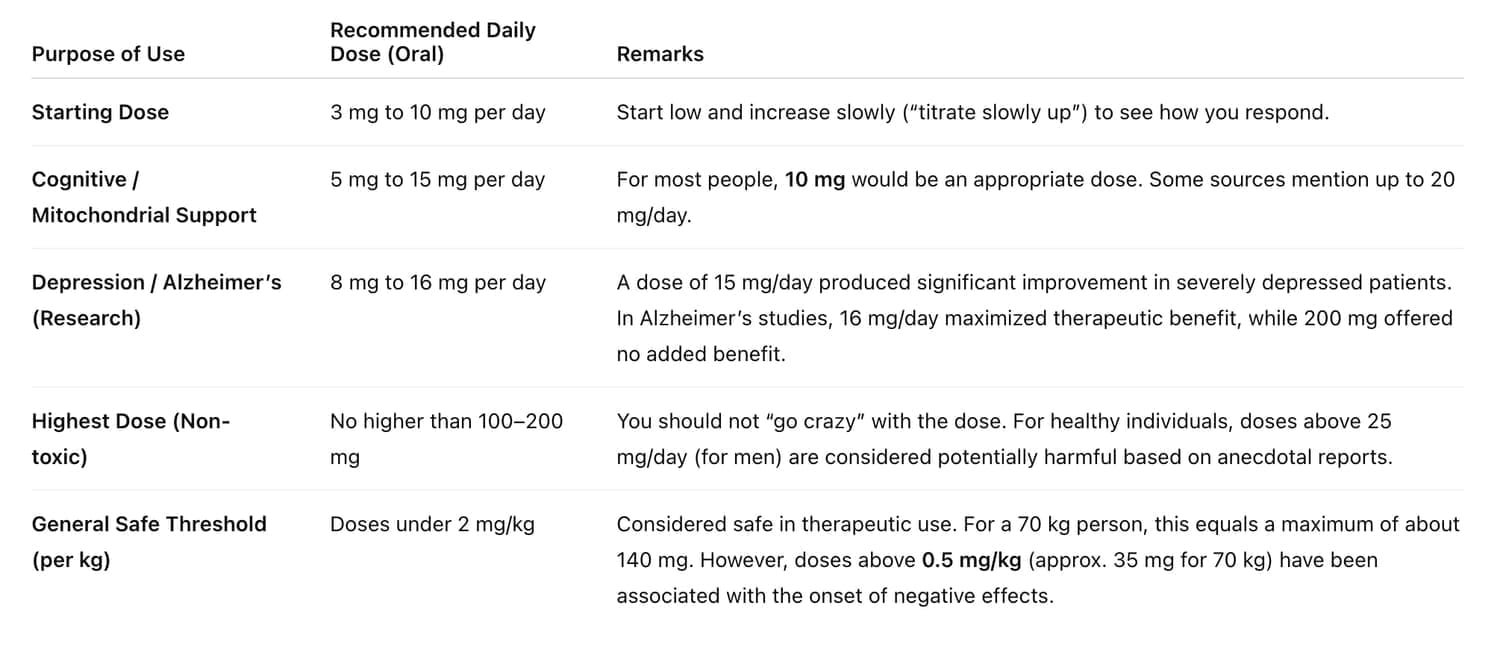
The dosage of methylthioninium chloride (methylene blue) depends greatly on the purpose of administration (medical emergency versus experimental/supplemental use) and the route of administration.
Accepted Intravenous Doses are not provided here. It is evident that IV use must always take place under the supervision of a physician or medical specialist.
Doses for Experimental or Supplemental Use (Oral)
For non-toxicology and non-hospital use (such as “supplement” or “brain booster” purposes), the dosage range varies widely.
Methylene blue exhibits a hormetic effect, meaning that low doses offer beneficial effects (as an antioxidant and mitochondrial enhancer), while high doses may cause the opposite (acting as a pro-oxidant and increasing oxidative stress).
General Low Doses:
Doses below 2 mg/kg are considered safe in therapeutic contexts and rarely cause side effects.
A dose of 15 mg/day showed significant improvement in patients with severe depression.
In an Alzheimer’s study, 16 mg/day provided maximum therapeutic benefit, while a much higher dose of 200 mg offered no additional advantage.
In a study with healthy participants, oral doses of 0.5 to 4.0 mg/kg were used to improve memory and attention span.
Oral Dosage Ranges:
Some sources indicate that people may respond to 5 or 10 mg orally, while others respond only at 50 to 100 mg.
Recommended Starting Dose (Oral, Non-Clinical):
Some sources recommend beginning with a daily dose of 10 mg, divided into smaller doses, which can then be increased as needed.
Note:
If you are using a 1% methylene blue solution, each drop contains approximately 0.5 mg of methylene blue.
Important Safety Warnings
The use of methylene blue is not without risks, especially when incorrectly dosed or combined with certain medications.
Serotonin Syndrome:
Methylene blue is a monoamine oxidase inhibitor (MAOI). It must not be taken together with certain medications for depression or anxiety (such as SSRIs, SNRIs, and other serotonergic agents), as this can trigger potentially fatal serotonin syndrome.G6PD Deficiency:
It should not be used by patients with glucose-6-phosphate dehydrogenase (G6PD) deficiency due to the risk of hemolytic anemia.Product Purity:
Only pharmaceutical-grade (USP-grade) methylene blue should be used for human consumption. Lower (industrial or chemical) grades often contain heavy metals and other contaminants.Overdose:
Doses above 2 mg/kg can cause side effects. At doses ≥ 7 mg/kg, overdose may lead to nausea, chest pain, confusion, elevated methemoglobin levels, and blue discoloration of the skin.
Dosage in Drops (Based on a 1% Solution)
If you are using a 1% pharmaceutical-grade methylene blue solution, each drop generally contains 0.5 mg of methylene blue.

Important Safety Guidelines Regarding Dosage
When determining a safe dose, the following risks must be taken into account:
Quality Is Critical:
Always ensure you are using USP (United States Pharmacopeia) pharmaceutical-grade methylene blue. Lower industrial or chemical grades often contain heavy metals and contaminants that are toxic, especially at higher doses.
Serotonin Syndrome:
Methylene blue is a monoamine oxidase inhibitor (MAOI), even at doses below 1 mg/kg.
Concurrent use with serotonergic medications (such as SSRIs, SNRIs, and bupropion) must be avoided due to the risk of life-threatening serotonin syndrome.
If administration cannot be avoided, the lowest possible dose should be used, and the patient should be closely monitored for up to 4 hours after dosing.
Timing:
It is recommended to take methylene blue early in the day (morning or early afternoon), as it can have an activating effect.
The half-life is between 5 and 7 hours, which is why some people take it twice per day (for example, in the morning and around 1:00 p.m.).
Cyclic Use:
Some experts advise not taking it year-round but instead using it cyclically (e.g., four to five days per week, or several weeks on followed by a week off).
G6PD Deficiency:
Methylene blue must not be used by individuals with glucose-6-phosphate dehydrogenase (G6PD) deficiency due to the risk of hemolytic anemia.
Important Note:
Because methylene blue is a medication and because the risk of interactions with other substances (such as serotonergic medications or in cases of G6PD deficiency) is real, it is strongly recommended to always consult a physician or pharmacist before starting methylene blue.
Noël

“What are the benefits of methylene blue? A medical review” (July 2025)
Provides an overview of how methylene blue is used: antioxidant, neuroprotective, possible cognitive support, and enhancement of mitochondrial energy production. Also warns about limited data and risks. Drugs.com
“The Potentials of Methylene Blue as an Anti-Aging Drug” (2021, review article)
Summary of studies (mostly preclinical) showing that methylene blue reduces oxidative stress, supports mitochondrial function, and may be beneficial in age-related conditions such as neurodegeneration and skin aging. PMC
“Methylene Blue” (overview in NCBI / StatPearls)
Describes the accepted medical indication (methemoglobinemia) and research into use for circulatory issues, shock, etc. Emphasizes that dosage, method of administration, and supervision are crucial. NCBI
“Methylene-blue benefits: Medical, anti-aging, and more” (MedicalNewsToday, Sept 2025)
Discusses potential for reducing oxidative damage, relevant to aging, neurodegeneration, and skin health. Also stresses that human studies are still lacking or limited. Medical News Today
Harvard Health Publishing — “What to know about methylene blue”
Historical and medical overview — methylene blue was first used as a dye, later in medicine (including early malaria treatment). Shows that it is a drug with specific, well-studied indications, not a general-purpose “miracle cure.” Harvard Health
Created by © Noël